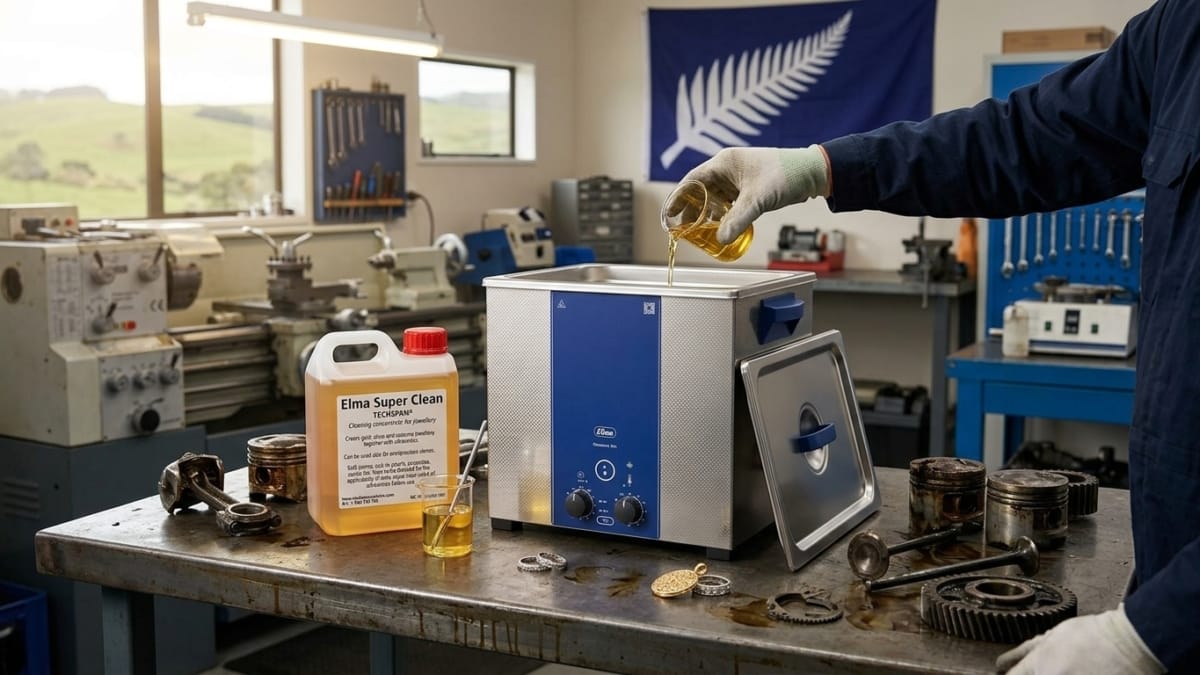
The single biggest factor in how well your ultrasonic cleaner performs isn’t the machine — it’s the cleaning solution you put in it. Run plain tap water and you’ll get mediocre results. Add the right concentrate at the right dilution and the same cleaner will strip oil, grease, polishing paste, carbon, rust and oxidation in minutes.
This guide explains how ultrasonic cleaning solutions work, the three chemistry types, and exactly which Elma concentrate to choose for your material and the contamination you’re removing. Everything below is drawn from the Elma cleaning chemicals range stocked here in New Zealand.
Why the solution matters more than you think
Ultrasonic cleaners work by cavitation — millions of microscopic bubbles forming and collapsing against the surface of your parts, scrubbing every crevice the eye can’t reach. (If you want the detail, see How ultrasonic cleaning works.)
A purpose-made cleaning concentrate does three things plain water can’t:
- Lowers surface tension so cavitation bubbles form more readily and reach into fine detail.
- Chemically lifts and holds contamination — emulsifying oils and grease, or dissolving rust and limescale — so it doesn’t redeposit on the part.
- Protects the substrate with corrosion inhibitors and a pH matched to your material.
Using the wrong chemistry — or worse, household detergent — at best cleans poorly and at worst etches, stains or corrodes the very parts you’re trying to clean. That’s why Elma supplies a matched range rather than a single “do-everything” liquid.
The three types of ultrasonic cleaning solution
Every Elma concentrate falls into one of three chemistry families, defined by pH:
| Type | pH | What it does | Typical use |
|---|---|---|---|
| Alkaline (A-series) | ~10.8 – 13.4 | Emulsifies and lifts oils, grease, soot, lubricants and polishing media | Universal and heavy-duty workshop cleaning |
| Neutral (N-series) | ~9.3 | Gentle, material-safe cleaning that won’t attack sensitive surfaces | Mixed metals, plastics, optics, delicate parts |
| Acidic (S-series) | ~1.6 | Dissolves rust, limescale, oxide films and mineral deposits | De-rusting and descaling metal |
Get the family right first, then narrow down to the specific grade.
The Elma range at a glance
All Elma concentrates are supplied in 1-litre bottles (with 5L and 20L on the Allkleen range) and diluted with water — typically 3–10%, some down to 1:60 for light work — so a single bottle goes a very long way. Check each product page for current New Zealand pricing.
| Solution | Chemistry | pH | Best for | Removes |
|---|---|---|---|---|
| TEC CLEAN A1 | Alkaline, silicate & phosphate-free | 10.8 | Electronics, PCBs, optics, glasses, plastics | Light oils, grease, flux, atmospheric dust |
| TEC CLEAN A2 | Alkaline, contains ammonia | 11.0 | Non-ferrous & precious metals, brass, nickel, titanium, jewellery | Grinding & polishing paste, lapping media, grease, oil |
| TEC CLEAN A3 | Alkaline, emulsifying | 13.0 | Stainless, steel, iron, titanium, precious metals | Punching oils, drawing grease, soot, cooling lubricants |
| TEC CLEAN A4 | Alkaline, de-emulsifying | 13.4 | The all-rounder — steel, aluminium, light metals, brass, plastics, ceramics, glass | Oil, grease, soot, coking, fingerprints |
| TEC CLEAN A5 | Alkaline powder | 11.5 | Stainless, steel, iron, aluminium, light metals | Resinified oil & grease, polishing media, lacquer, paint, wax |
| TEC CLEAN N1 | Neutral, material-safe | 9.3 | All metals, plastics, ceramics, glass, rubber | Oil, grease, grinding paste, lapping & polishing media, sweat, fingerprints |
| TEC CLEAN S1 | Acidic, mild | 1.6 | De-rusting & descaling stainless, steel, aluminium, brass | Rust, limescale, oxide films, grease, oil |
| SUPER CLEAN | Mild alkaline w/ ammonia | — | Jewellery — gold, silver, hard-stone pieces | General soiling; brightens precious metals |
| ALLKLEEN INDUSTRIAL | Aqueous concentrate | — | Automotive, carburettors, diesel & general engineering | Oil, grease, carbon, soot, waxes |
| ALLKLEEN DAIRY | Aqueous concentrate | — | Dairy plant & equipment — a NZ-specific formulation | Milkstone, fats, protein and mineral deposits |
Note on aluminium: A4 is aluminium-safe, but stronger alkalis like A3 are not suitable for aluminium or light metals. With acidic S1, remove and rinse steel immediately after de-rusting to prevent flash corrosion. When in doubt, test on a scrap part first.
How to choose by material
- Stainless steel & steel — A3 or A4 for oils and grease; S1 if you’re removing rust or scale.
- Aluminium & light metals — A4 (specifically formulated to be aluminium-safe) or neutral N1.
- Brass & non-ferrous metals — A2 or N1; both clean without aggressive attack.
- Precious metals & jewellery — A2 or SUPER CLEAN for gold, silver and hard-stone pieces.
- Electronics, PCBs & optics — A1 (silicate and phosphate-free, gentle on fine assemblies).
- Plastics, ceramics, glass & rubber — neutral N1 is the safe universal choice.
- Mixed loads / general workshop — A4 is the closest thing to an all-rounder.
How to choose by contamination
- Oil, grease & cutting fluids ? alkaline A-series (A3/A4 for heavy industrial soiling, A1 for light).
- Polishing paste, grinding & lapping media ? A2 (jewellers) or N1.
- Rust, limescale & oxidation ? acidic S1.
- Carbon, soot & carburettor grime ? Allkleen Industrial or A3.
- Milkstone & dairy soils ? Allkleen Dairy.
- Flux residue on electronics ? A1.
Dilution, temperature and getting the most from a bottle
Because these are concentrates, correct dilution matters. As a rule of thumb the TEC CLEAN grades run at 3–10% in water, while the aqueous Allkleen concentrates go much further. Most jobs also clean faster warm: many solutions are designed to run around 60–70 °C, which is why most Elma cleaners include adjustable heating.
A practical consequence: a single 1-litre bottle of concentrate makes many baths of working solution, so the cost-per-clean is low. Always add concentrate to water (not the other way around), degas a fresh bath for a few minutes, and replace the solution once it’s visibly loaded with contamination.
A word on household substitutes
It’s tempting to reach for dish soap or a degreaser from the shelf. Don’t. Household detergents foam — and foam kills cavitation, the entire mechanism your cleaner relies on. They also lack corrosion inhibitors, so they can leave parts spotted or tarnished. Purpose-made ultrasonic concentrates are low-foaming and substrate-matched for exactly this reason.
Which one should you buy?
If you want a simple starting point:
- General workshop / mixed parts: TEC CLEAN A4
- Sensitive parts, plastics & optics: TEC CLEAN N1 or A1
- Jewellery: SUPER CLEAN or TEC CLEAN A2
- Rust & scale removal: TEC CLEAN S1
- Automotive & carburettors: Allkleen Industrial
- Dairy: Allkleen Dairy
Browse the full ultrasonic cleaning chemicals range for current pricing and data sheets, pair it with the right machine using our guide to choosing an ultrasonic cleaner, or contact our New Zealand team and we’ll match a solution to your application.

For nearly 38 years, Tim Fastnedge has been a driving force behind Techspan’s expertise in ultrasonic cleaning equipment. His knowledge of ultrasonic cleaners is extensive, allowing him to recommend the most effective cleaning solution for any application.
Tim’s dedication extends beyond sales; he’s passionate about empowering customers with the right tools to achieve optimal cleaning results. So when it comes to Elma Ultrasonics New Zealand’s range of high-quality equipment, look no further than Tim’s expertise at Techspan.